
System-integrated image processing in real-time
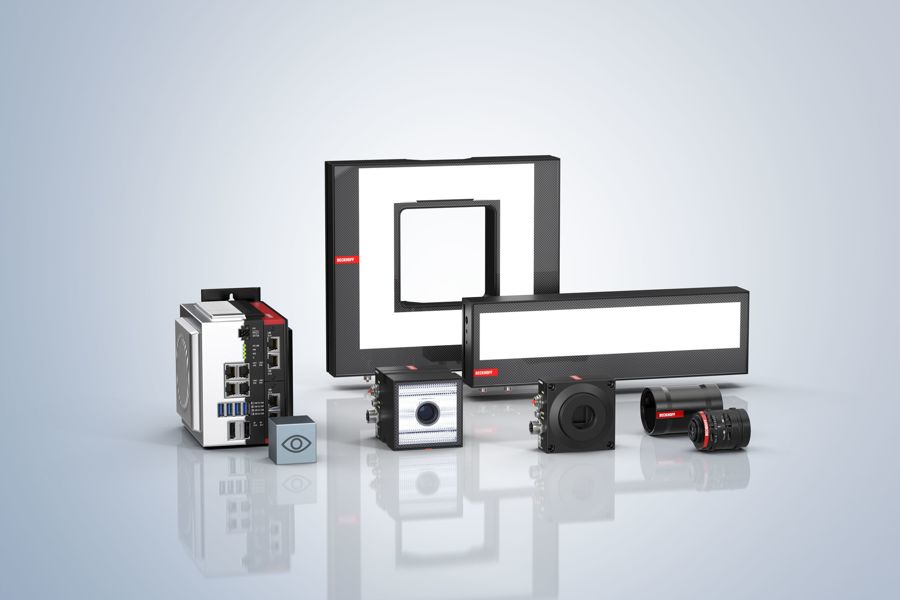
From October 6 to 8, Beckhoff will be appearing at VISION in Stuttgart and demonstrating how vision applications can be implemented in full synchronization with PLCs, motion control, and robotics. Image processing thus evolves from an add-on to an integral part of the machine control system – eliminating latencies and the need for additional interfaces.
Machine vision is evolving from a downstream test system into a key technology for quality assurance, track and trace, and adaptive process control. In the process, Beckhoff is breaking down the traditional divide between vision and automation technology: With TwinCAT Vision, image processing algorithms run in the same real-time environment and within the same tasks as PLC, motion control, and robotics. This ensures synchronous processing, shorter response times, and deterministic behavior.
Complete portfolio
On the hardware side, Beckhoff will present a comprehensive, seamlessly integrated portfolio at VISION 2026. The EtherCAT-compatible VCS2000 series area-scan cameras, rated to IP65/67, feature monochrome and color Sony CMOS sensors that deliver resolutions of up to 24 megapixels at a transmission rate of 2.5 Gbit/s. Additional highlights include rugged C-mount lenses with VIS and NIR AR coatings, a resolution of up to 2 µm, and image circles of 11 mm and 19.3 mm respectively. The multi-color LED lights – available in bar, area, and ring configurations – operate at different wavelengths and allow for spectral adjustment during the process. This allows users to achieve the best possible contrast between the inspection feature and its surroundings in a reproducible manner and without the need for time-consuming readjustments. To get started quickly or to integrate the system into existing control environments, Beckhoff offers the VUI all-in-one unit, which includes a camera, illumination, and electronically focusable optics. A key distinguishing feature is the integration via EtherCAT P: Data and power are transmitted over a single cable, and devices are powered in a cascaded configuration by a single power supply unit. When combined with the distributed clock function, the camera and illumination can be synchronized with all machine processes to within a microsecond.
From a software perspective, the system remains open. Cameras from any manufacturer with a GigE Vision interface can be integrated directly into the TwinCAT architecture without the need for third-party software. Configuration is performed via a network scan, just as it is for an axis. TwinCAT 3 Vision Base provides a library for algebraic image operations, filters, Fourier analysis, color image processing, segmentation, and contour and blob analysis. TwinCAT 3 Vision Matching 2D adds template matching and keypoint detection for OK/NOK decisions and object classification. Configurable multi-core support and job tasks for automatic parallelization enable the full computing power of the industrial PCs to be utilized.
Analytics and machine learning
Beckhoff bridges the gap to data-driven production with TwinCAT Analytics, which enables seamless data recording and analysis, and with TwinCAT 3 Machine Learning, which executes neural networks directly in the runtime at the application clock rate. This creates end-to-end processes for users, ranging from image capture through AI-assisted quality control to preventive maintenance.
News release from Beckhoff, 23/09/2026